Wildlife Spots
Discover the best locations in the UK to spot amazing wildlife!

From skylarks in May to woodpeckers in August, the UK has a lot to offer when it comes to locations brimming with extraordinary wildlife. With a diverse mix of woodland, heathland and expansive coastlines, the UK is home to a colourful array of wildlife spots to explore.
Packed with wildlife havens, there’s no denying that UK's beautiful natural landscapes offer awe-inspiring glimpses of the natural world - but where in the country are the best places to find amazing wildlife?
Get your favourite walking boots on and your outdoor essentials as we reveal the best wildlife spotting locations in the UK. Discover the best places to visit if you want to find native species in their spectacular surroundings, as well as the best months to spot different types of wildlife.
Jump to a topic
Best locations to spot UK wildlife
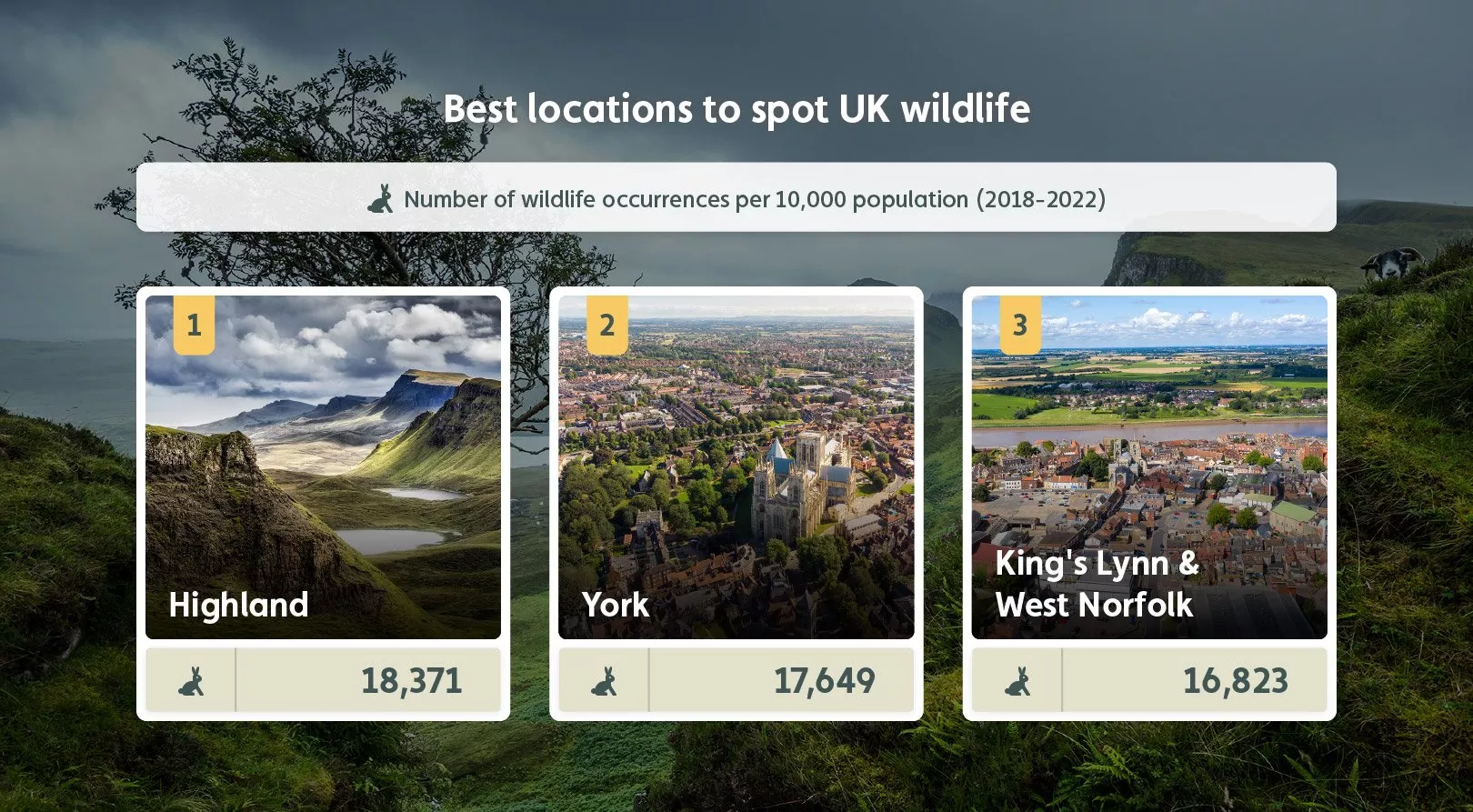
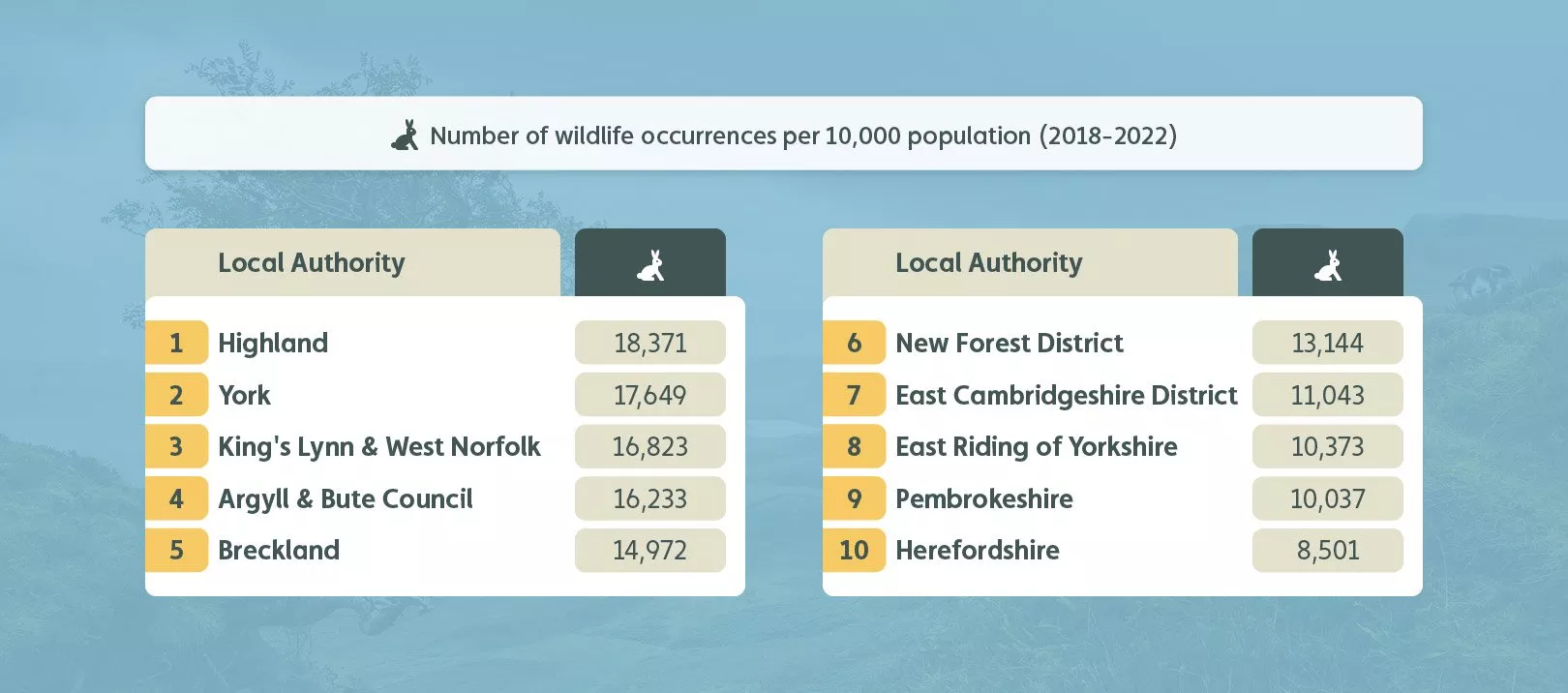
1. Highland - Number of wildlife occurrences per 10,000 population (2018-2022): 18,371
Want the best chances of spotting amazing wildlife? Then visiting the Scottish Highlands is probably your best bet. The Highland local authority is the largest local government area in the UK, here you can spot robins, heathers and damselflies aplenty. It also had the highest number of wildlife occurrences between 2018 and 2022 with a total of 18,371 per 10,000 population.
2. York - Number of wildlife occurrences per 10,000 population (2018-2022): 17,649
Ranking in second place in York and its surrounding areas, which had a total of 17,649 wildlife occurrences per 10,000 population. Not only is this local authority and festival city surrounded by Roman roots with an intriguing Viking past, but it is also a top spot to experience wildlife such as blackbirds and bluetits at its finest.
3. King's Lynn and West Norfolk - Number of wildlife occurrences per 10,000 population (2018-2022): 16,823
Based in the town of King's Lynn, the King's Lynn and West Norfolk local authority area completes the top three with an estimated total of 16,823 wildlife occurrences per 10,000 population. This location is surrounded by maritime heritage and outstanding historic buildings. It also has a large number of designated wildlife-protected sites which are easily accessible, where you can spot Goldfinches.
Wildlife species with the most occurrences and where to spot them
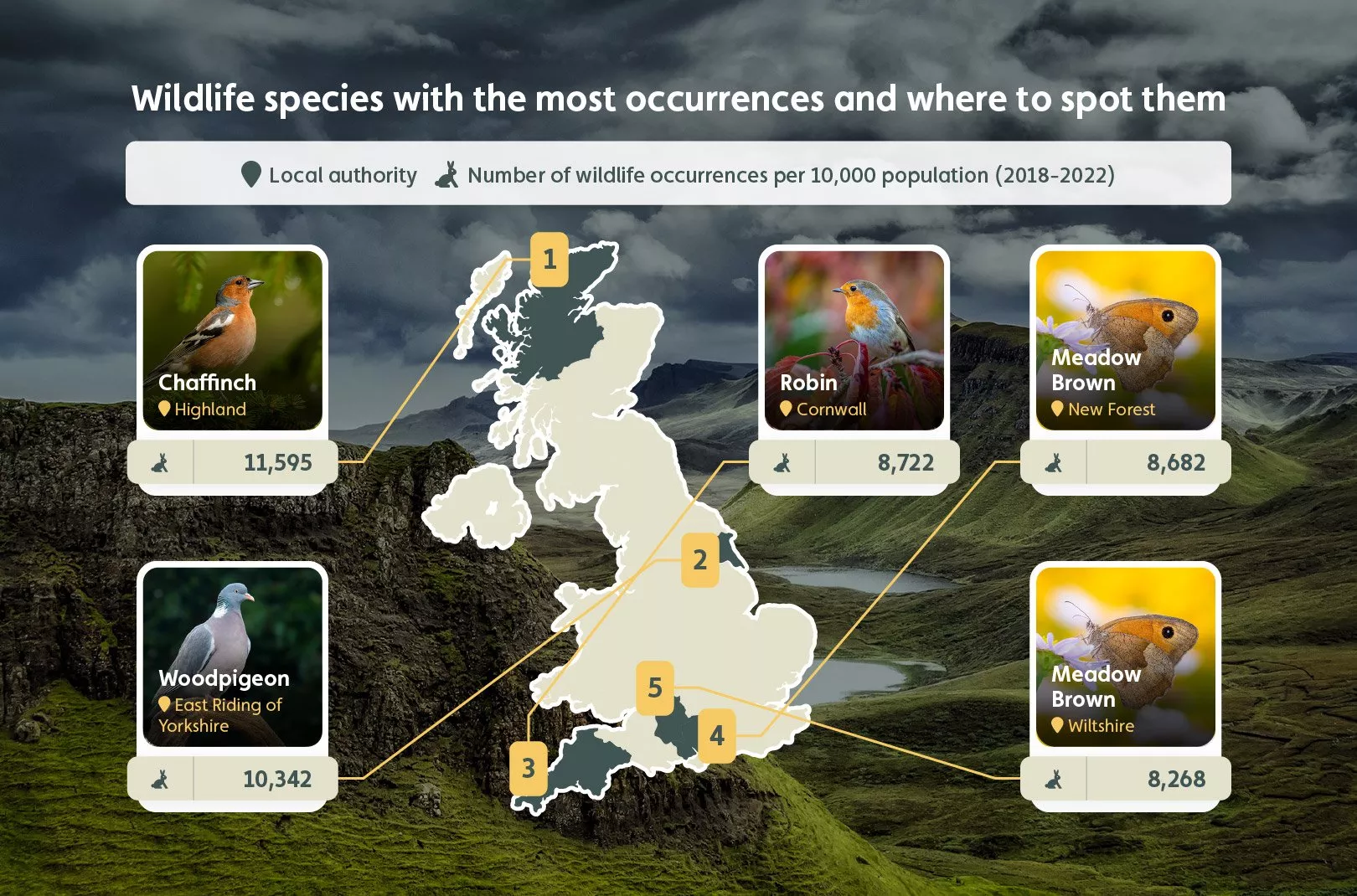
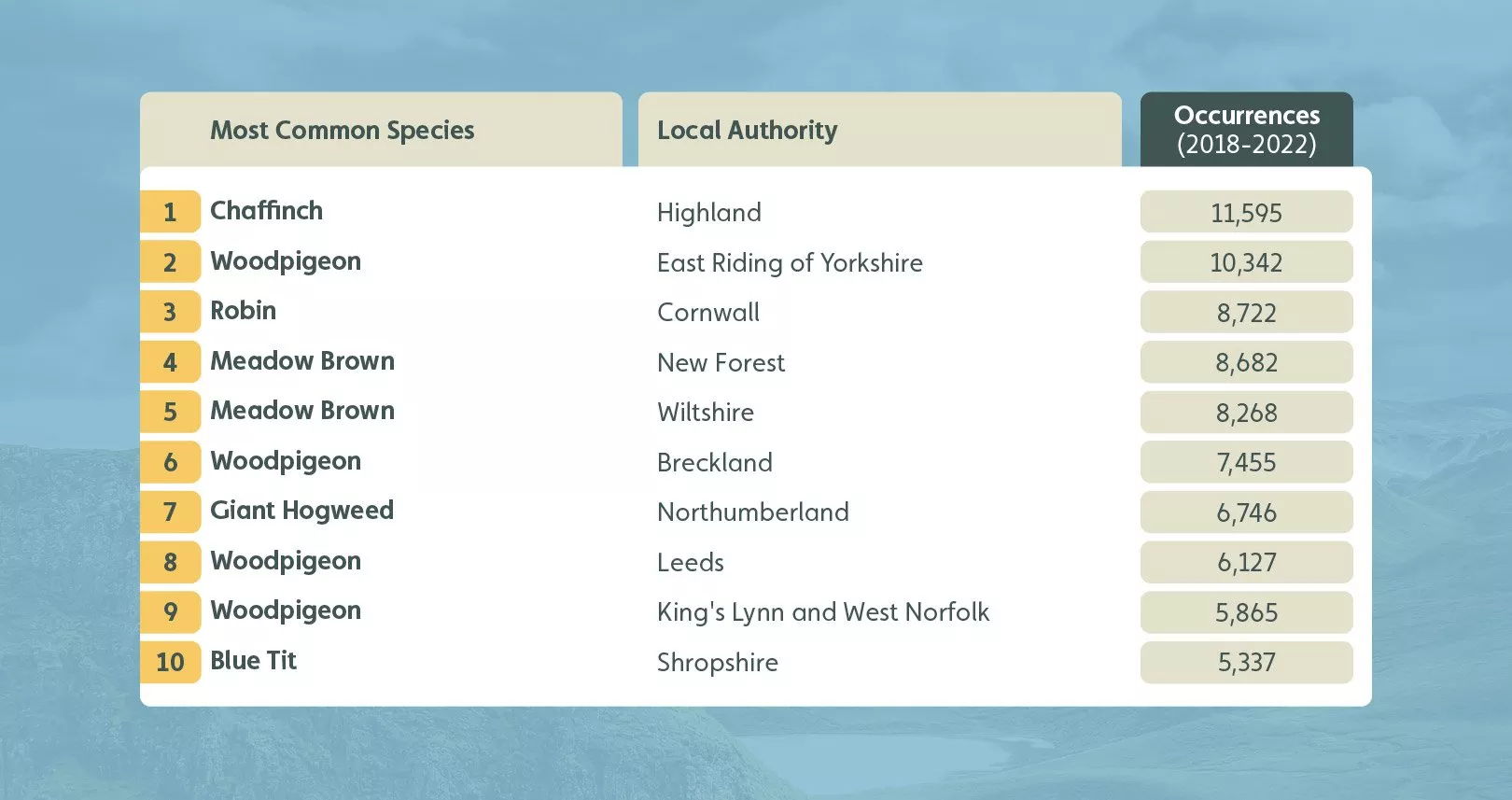
1. Chaffinch Location: Highland Number of occurrences (2018-2022): 11,595
Highland takes the lead as the local authority area with the most wildlife overall. Covering nearly a third of Scotland’s total area, this location is home to thousands of species. In fact, between 2018 and 2022, there were approximately 11,595 recorded occurrences of the chaffinch. Not only is this small passerine bird the most spotted wildlife in the Highland area but it is also one of the most widespread and abundant birds in Britain and Ireland.
2. Woodpigeon Most common species: East Riding of Yorkshire Number of occurrences (2018-2022): 10,342
The East Riding of Yorkshire follows behind in second place. This location has a recorded total of over 10,000 occurrences between 2018 and 2022 of the common woodpigeon. Small with grey heads and white neck patches, these birds can be found in gardens, parks and even on farmland and in woodlands.
3. Robin Most common species: Cornwall Number of occurrences (2018-2022): 8,722
The robin is the most commonly spotted wildlife in Cornwall, it is also the third kind of species to occur the most across the UK with a total of 8,722 occurrences. Largely known for their red chests, these passerine birds belong to the Chat subfamily of the Old World flycatcher family and often sing nearly all year round.
Rare wildlife you can find on your doorstep
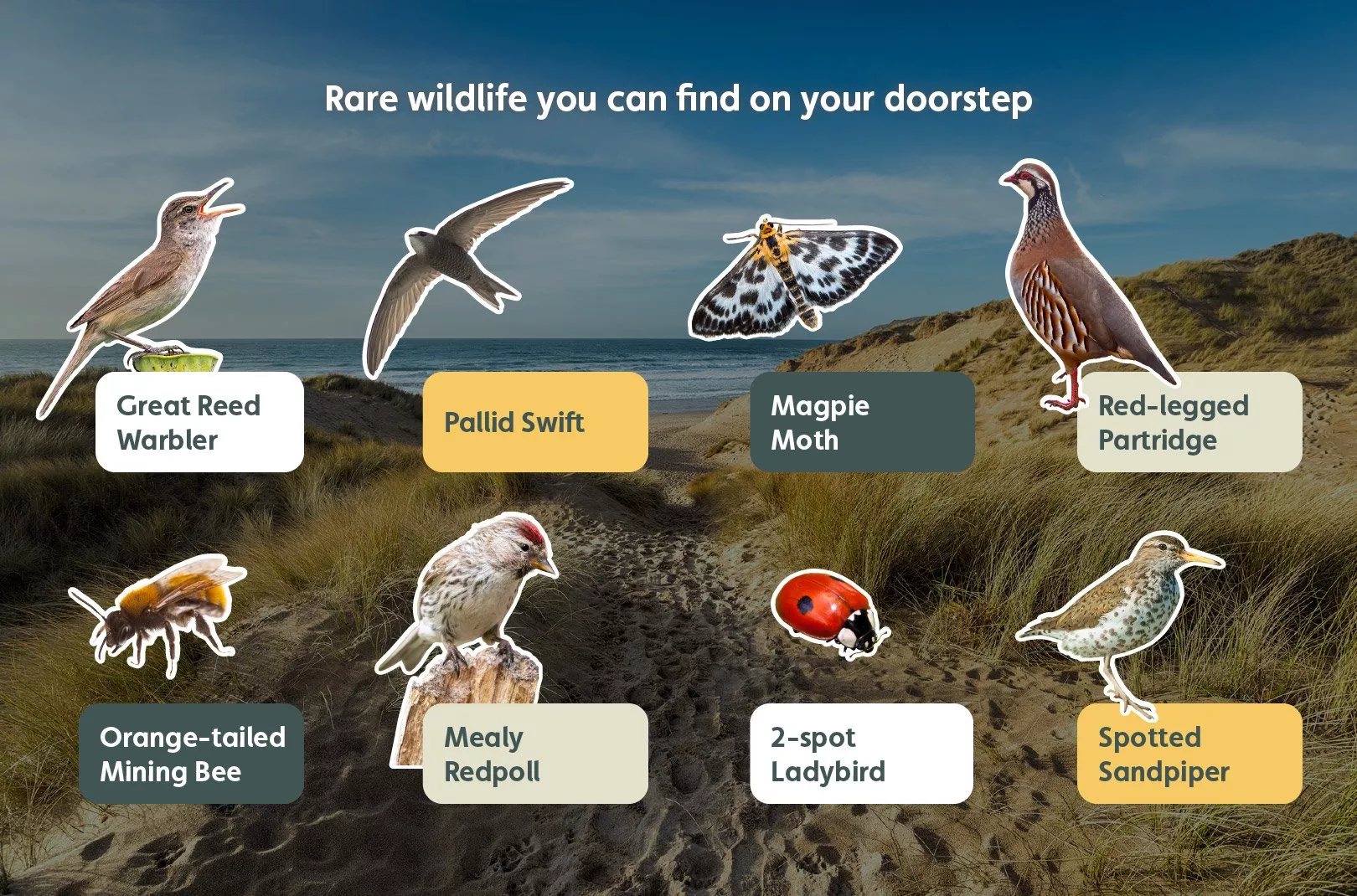
1. Spotted Sandpiper | Chocolate Mining Bee | Red-legged Partridge | Clouded Magpie | Rough Cockle | 2-spot Ladybird | Mealy Redpoll | Pallid Swift | Reed Warbler | Queen scallop | House Cricket | Great Reed Warbler | Ashy Button | Prickly Cockle | Magpie Moth | Lake Limpet | Ground-elder | Orange-tailed Mining Bee | Larch Ladybird | Arctic Redpoll | Aethusa cynapium | Number of occurrences - 1
Home to a variety of wonderful wildlife, the UK is surrounded by a haven of mysterious creatures and while we're used to seeing more common species, there are still plenty of rare species that dwell among us. As a matter of fact, between 2018 and 2022, hundreds of species were only spotted once - many of which can be found in areas such as Highland, East Riding of Yorkshire and the New Forest amongst others.
Records show that species such as the spotted sandpiper and the two-spot ladybird only had one occurrence. With so many opportunities to spot some rare animals and insects, keep your eyes peeled - you might just be lucky enough to find one at your doorstep!
The best months for spotting wildlife
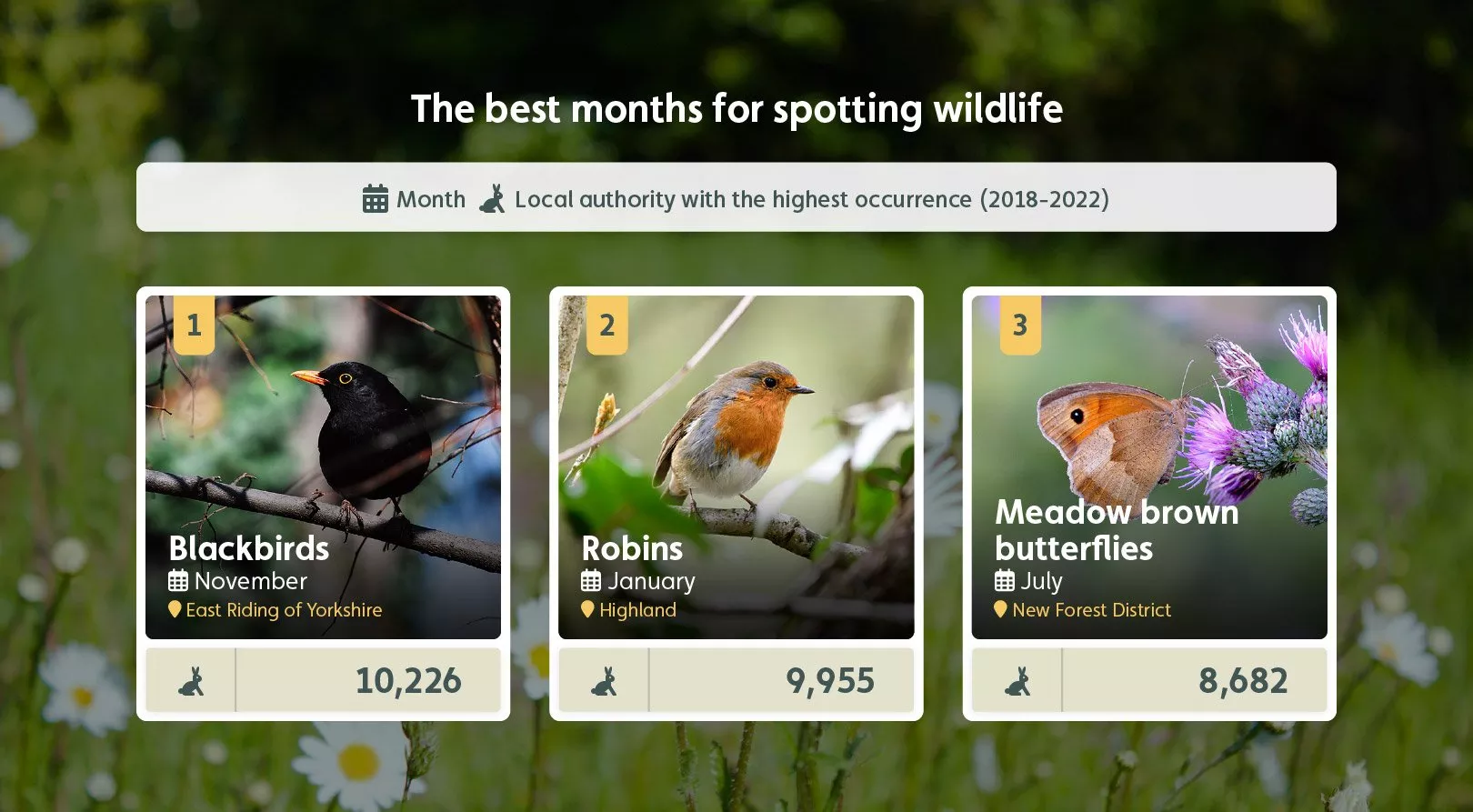
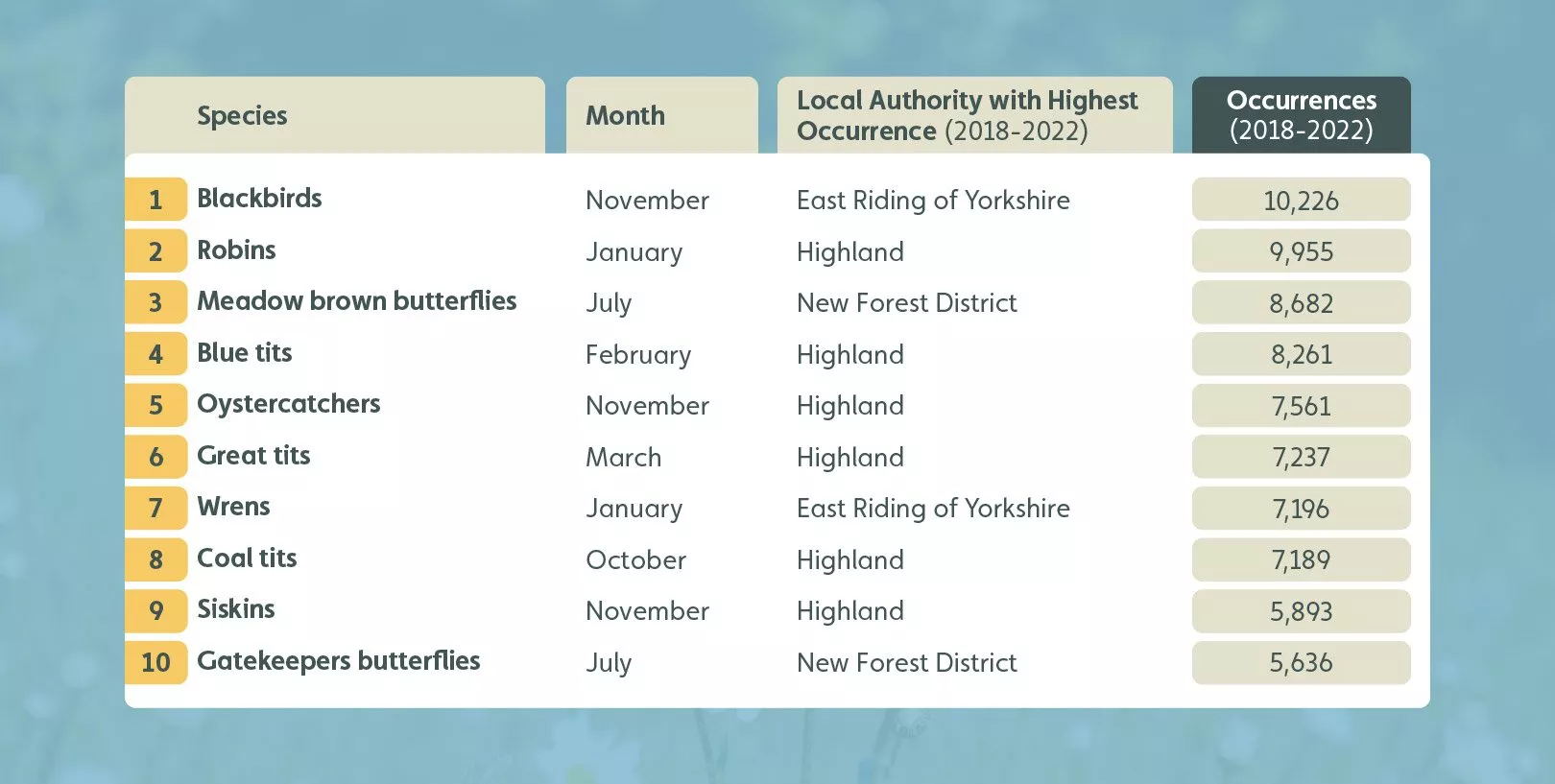
1. Blackbirds Month: November Local authority with the highest occurrence (2018-2022): East Riding of Yorkshire Number of occurrences: 10,226
If you’re looking to spot some amazing wildlife throughout the year then you’re in luck as the UK is surrounded by incredible wildlife all year round. But the best month to spot blackbirds is in November and they can typically be seen in the East Riding of Yorkshire area which saw approximately 10,226 blackbird occurrences between 2018 and 2022.
2. Robins Month: January Local authority with the highest occurrence (2018-2022): Highland Number of occurrences: 9,955
Dubbed the nation’s favourite garden birds, robins are largely spotted early in the year. You can expect them to make an appearance during January. Your best chances of easily spotting them are in the Highlands. This location had as many as 9,955 occurrences between 2018 and 2022.
3. Meadow brown butterflies Month: July Local authority with the highest occurrence (2018-2022): New Forest District Number of occurrences: 8,682
Most commonly seen during the summer months, meadow brown butterflies are one of the most prevalent grassland butterflies seen in the UK. The best area in which you will most likely spot a meadow brown is in the New Forest District, particularly in July.
How much does the UK spend on wildlife protection compared to other countries?
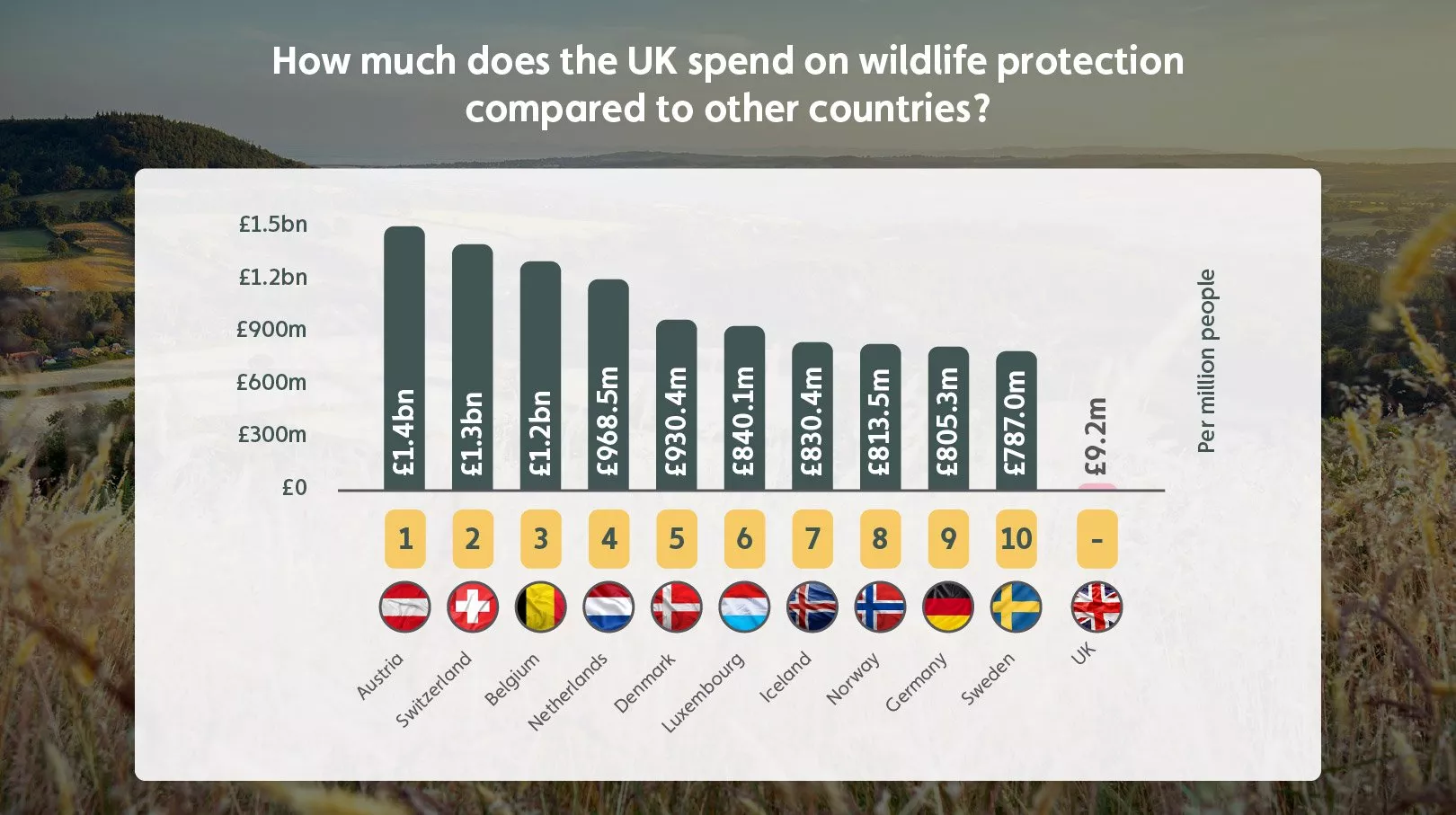
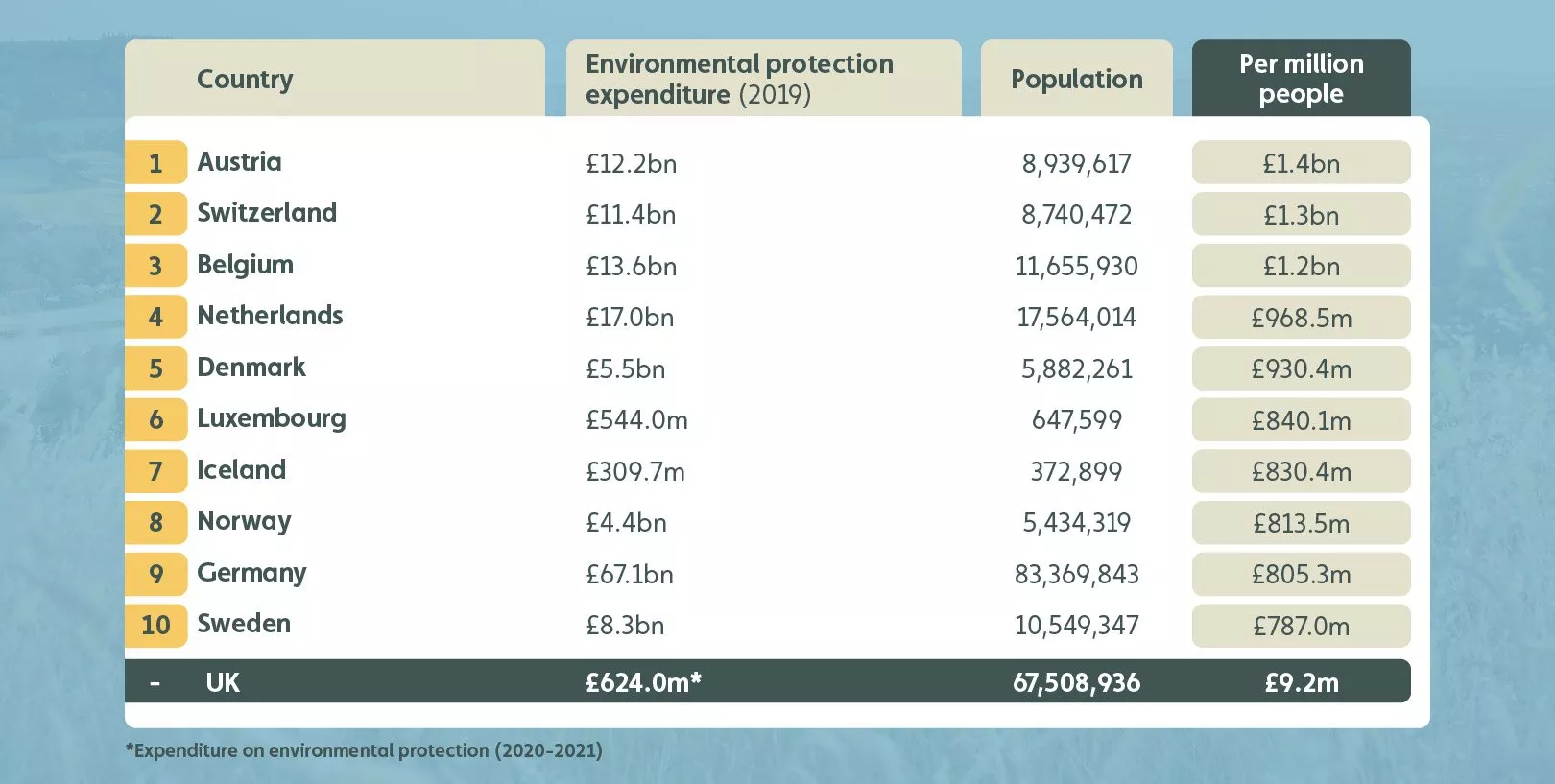
Regarding public sector spending on biodiversity, the UK allocated total funding of £624 million in 2020/2021. This is an increase of 103% in two decades. Considering that the UK has a population of over 67 million people, this funding equates to around a total of £9.2 million per one million population.
On the other hand, for non-governmental organisations, £243 million was spent with a particular focus on biodiversity and nature conservation. This highlights an increase of 16% when compared to ten years ago.
Although the UK has made a significant impact in increasing its total expenditure on biodiversity and nature conservation - how does this compare to other countries?
1. Austria Expenditure on environmental protection (2019): £12.2bn Population: 8,939,617 Per one million population: £1.4bn
In 2019, Austria spent a whopping £12.2bn on its environmental protection. This is unsurprising as the country is said to have one of the strictest regimes in the world. Austria places vital importance on biodiversity conservation and environmental issues. As a result, an average of £1.4bn is spent on the environment per one million population.
2. Switzerland Expenditure on environmental protection (2019): £11.4bn Population: 8,740,472 Per one million population: £1.3bn
Following closely behind is Switzerland, with a total expenditure of £11.4bn on environmental protection in 2019. The country strongly believes that the natural diversity of animals, plants and habitats needs to be preserved and promoted. This is seen in its funding for environmental protection. The country spent an estimated £1.3bn per one million population.
3. Belgium Expenditure on environmental protection (2019): £13.6bn Population: 11,655,930 Per one million population: £1.2bn
Next up is Belgium, in 2019 the country spent a total of £13.6bn on protecting the country’s environment. With a population of more than 11 million people, it is estimated that this would have cost £1.2bn per one million population.
Top wildlife species to look out for each month!
Best wildlife to spot in January
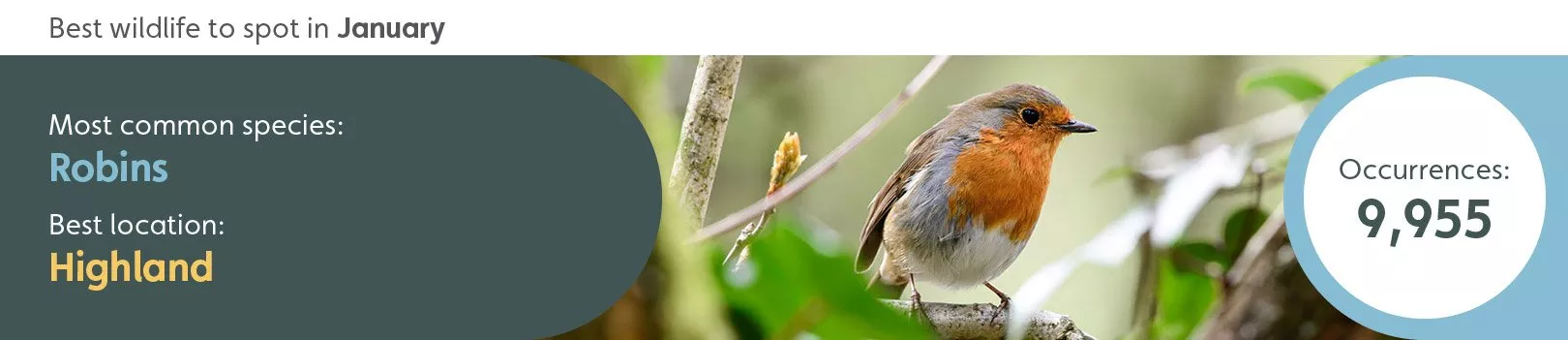
Most common species: Robins
Best location: Highland | Occurrences: 9,955
Though it is very possible to see robins all year round, they are particularly more widely spotted during the winter months, especially in January with their cherry-red breast. If you want the best chance of spotting robins then your best bet is visiting the Highland area in Scotland, which had the highest number of occurrences with 9,955 in just five years. Seen as Britain’s favourite birds, these popular creatures are known to be nocturnal singers. They often sing at night, in fact, they sometimes get mistaken for nightingales.
Best wildlife to spot in February
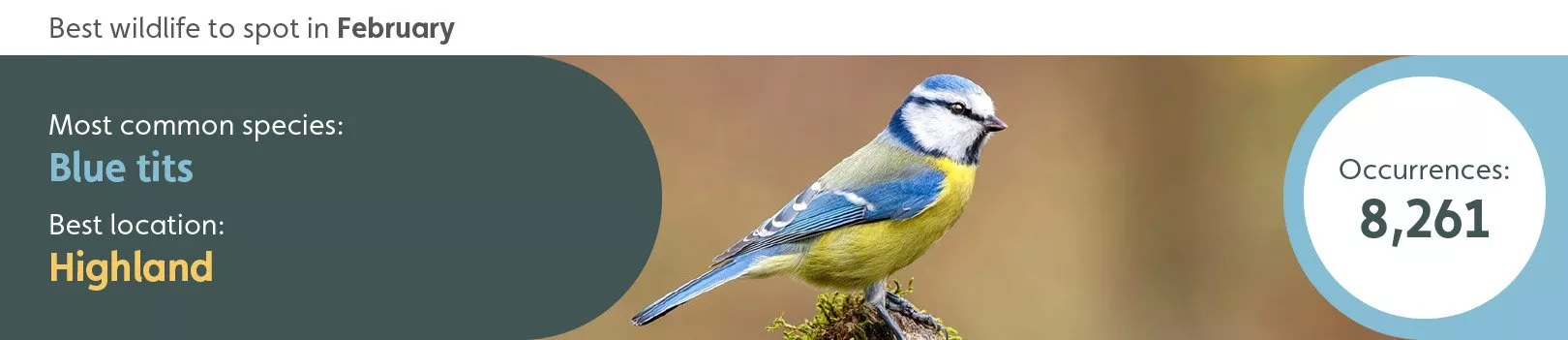
Most common species: Blue Tits
Best location: Highland | Occurrences: 8,261
A colourful mix of yellows, blues, greens and whites, blue tits are usually easy to recognise. They can be found all year round in woodlands, parks and gardens all across the country. They are most prevalent in the Scottish Highlands. From 2018 to 2022, over 8,000 blue tits were recorded.
February is the best time to see these vibrant birds. This is particularly because in winter daily flocks join together in search of food among plants and insects.
Best wildlife to spot in March
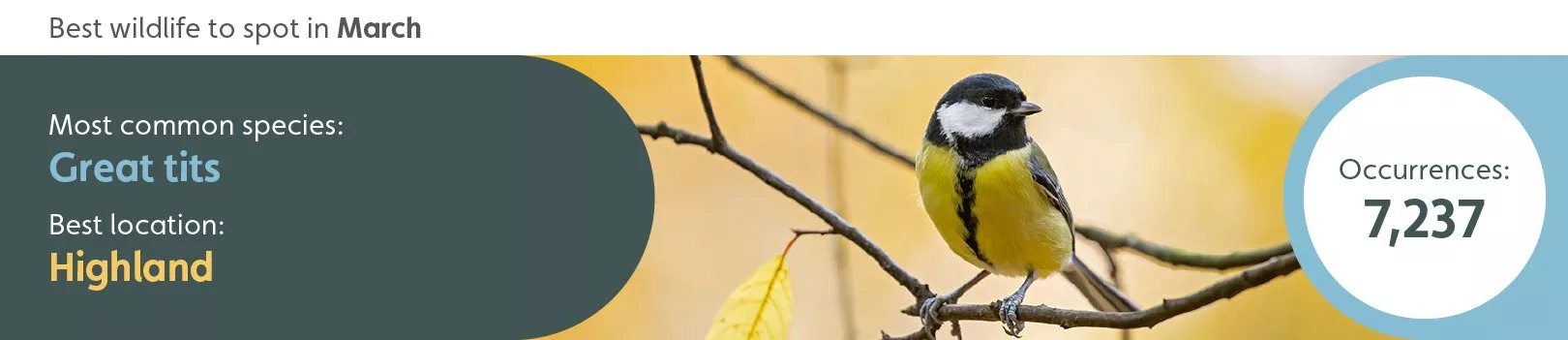
Most common species: Great Tits
Best location: Highland | Occurrences: 7,237
March is when you’ll most likely spot the largest UK tit. Green and yellow with a distinct glossy black head and white cheeks. Great tits are known to be woodland birds but you may also find them to be a familiar garden visitor. They have a striking two-syllable song and are highly popular within the Highland area, with an estimated 7,237 occurrences from 2018 to 2022.
Best wildlife to spot in April
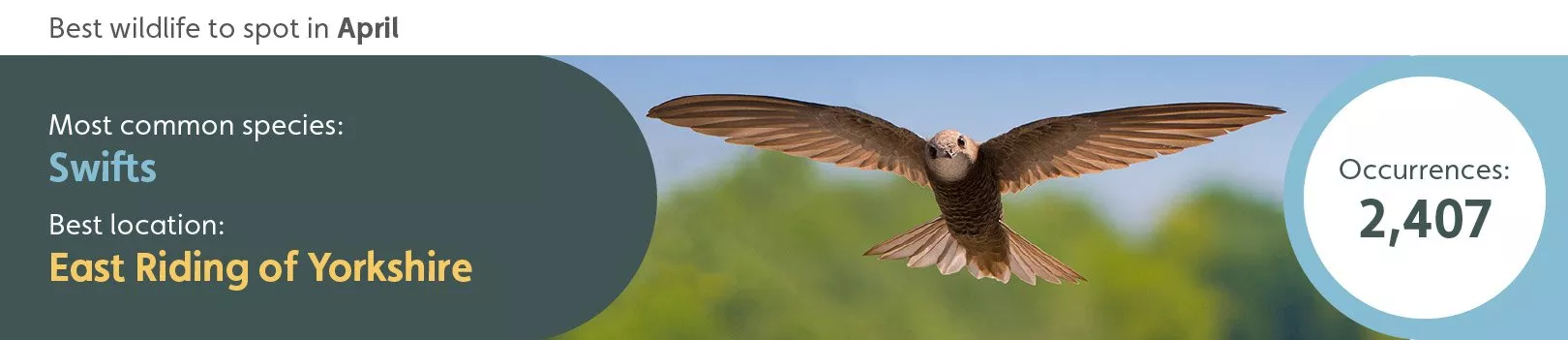
Most common species: Swifts
Best location: East Riding of Yorkshire | Occurrences: 2,407
Known to be superb flyers, swifts are medium-sized birds that rarely come in contact with the ground. Living up to their name, they are also one of the fastest birds with a top speed of an impressive 69 mph.
Having long, scythe-like wings and a short, forked tail, swifts are most commonly spotted in April, especially in the East Riding of Yorkshire, where over 2,400 were recorded between 2018 and 2022.
Best wildlife to spot in May
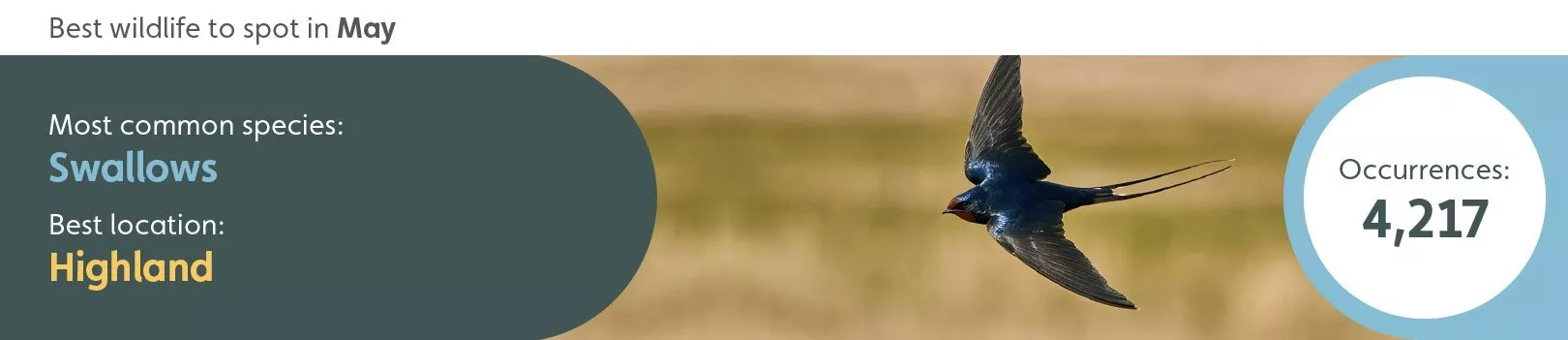
Most common species: Swallows
Best location: Highland | Occurrences: 4,217
Small with dark, glossy-blue backs, red throats and long tail streamers, swallows are known to be extremely agile in flight and much like swifts, most of their time is spent on the wing. They are more commonly spotted in the Highland area located in the Scottish Highlands, with an estimated 4,217 occurrences.
Best wildlife to spot in June
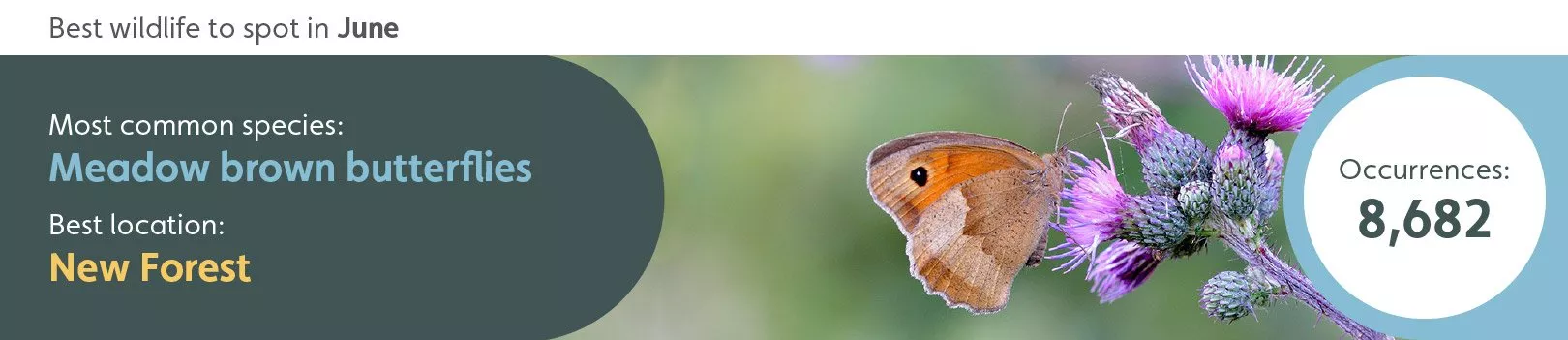
Most common species: Meadow brown butterflies
Best location: New Forest | Occurrences: 8,682
One of the most common grassland butterflies, the medium-sized meadow brown often makes an appearance in the warmer months of June to September. You will often see them in parks and gardens as they fly even in dull weather when many other butterflies don’t tend to be active. They are largely popular in the New Forest district, with over 8,682 occurrences recorded within just five years.
Best wildlife to spot in July
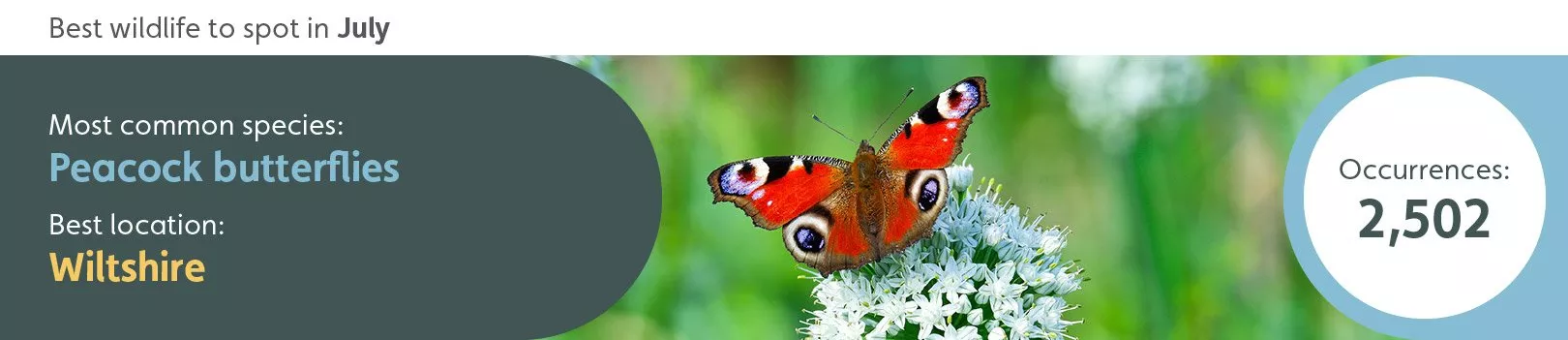
Most common species: Peacock butterflies
Best location: Wiltshire | Occurrences: 2,502
Lavished with brownish-red wings, the peacock butterfly is one of the most common garden butterflies found in England and Wales. Due to an increase in warmer weather and sunnier days in July, you may start to see a welcoming sight of butterflies such as peacocks fluttering around parks and gardens.
Wiltshire is a great location to witness peacock butterflies in their element as these majestic creatures were spotted over 2,500 times in that area from 2018 to 2022.
Best wildlife to spot in August
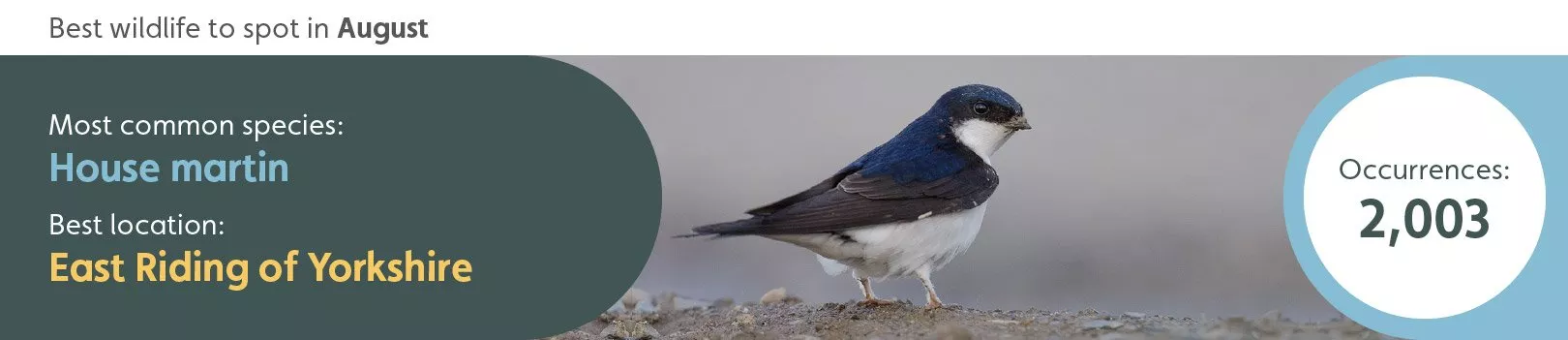
Most common species: House martin
Best location: East Riding of Yorkshire | Occurrences: 2,003
These small birds usually have glossy blue-black upper parts and are pure white underneath. As summer migrants, you will most likely spot house martins in August. The best place to find these distinctive white rump and forked-tailed birds are in the East Riding of Yorkshire, where 2,003 occurrences were recorded between 2018 to 2022.
Best wildlife to spot in September
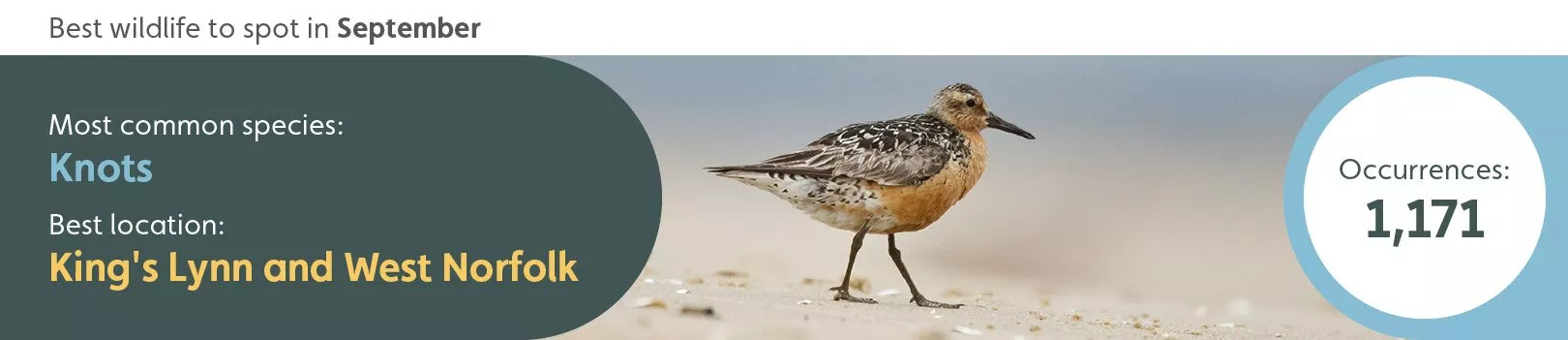
Most common species: Knots
Best location: King's Lynn and West Norfolk | Occurrences: 1,171
Recorded over one thousand times in the King's Lynn and West Norfolk area in five years, Knots are described as stocky little sandpipers. They are often spotted in estuaries around the coast, especially in September.
Interestingly, these knots are fairly large and chunky. They have short legs, green legs and in winter they’re silvery-grey on top and white underneath, whilst in summer they are brick-red underneath and have speckled, rust-brown upper parts.
As long-distance migrants, knots can travel up to an impressive 15,000km. They usually stop to feed at least once and eat things such as molluscs, crustaceans and invertebrates.
Best wildlife to spot in October
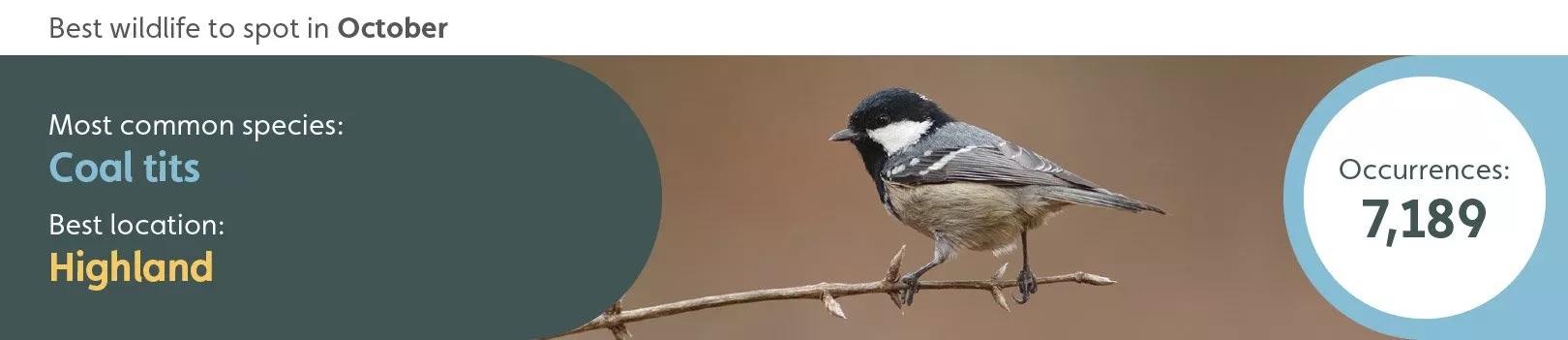
Most common species: Coal tits
Best location: Highland | Occurrences: 7,189
Most likely to be spotted in October, coal tits have distinctive grey backs, black caps, and white patches at the backs of their neck. They also have a smaller and slimmer bill than great and blue tits and are often regular visitors to most feeders.
Popular in the Highland area and with a record of 7,189 occurrences, coal tits are often spotted in woodlands, parks, conifer woods and gardens.
Best wildlife to spot in November
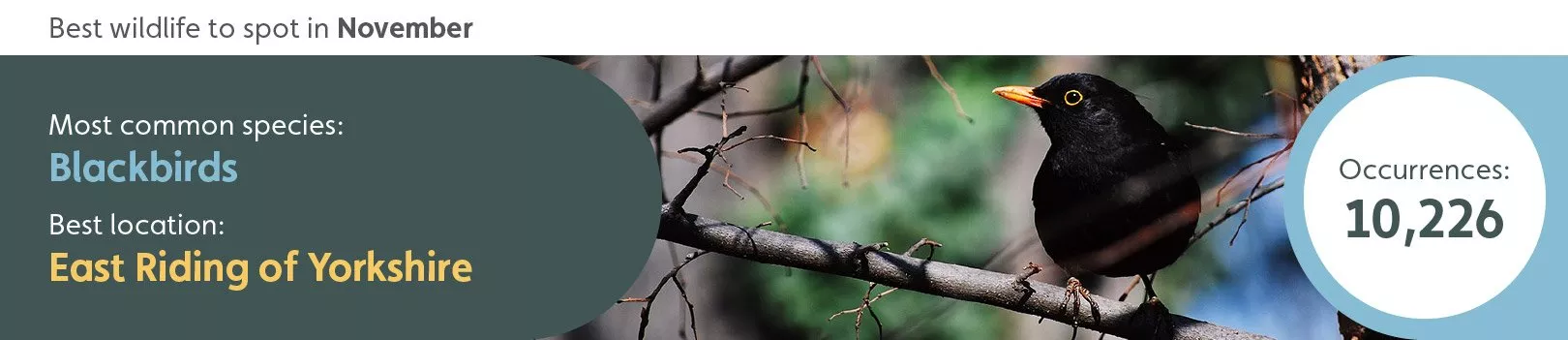
Most common species: Blackbirds
Best location: East Riding of Yorkshire | Occurrences: 10,226
Blackbirds are very common in the UK. Not only are they one of the most striking birds but their mellow songs are also a favourite. Although Blackbirds can be seen all year round, you have more of a chance to spot them in the later part of the year, especially in November.
They had the most number of occurrences between 2018 and 2022, with an estimated total of 10,226 in the East Riding of Yorkshire alone. Blackbirds can be found anywhere from gardens to the countryside, from hills to coasts.
Best wildlife to spot in December
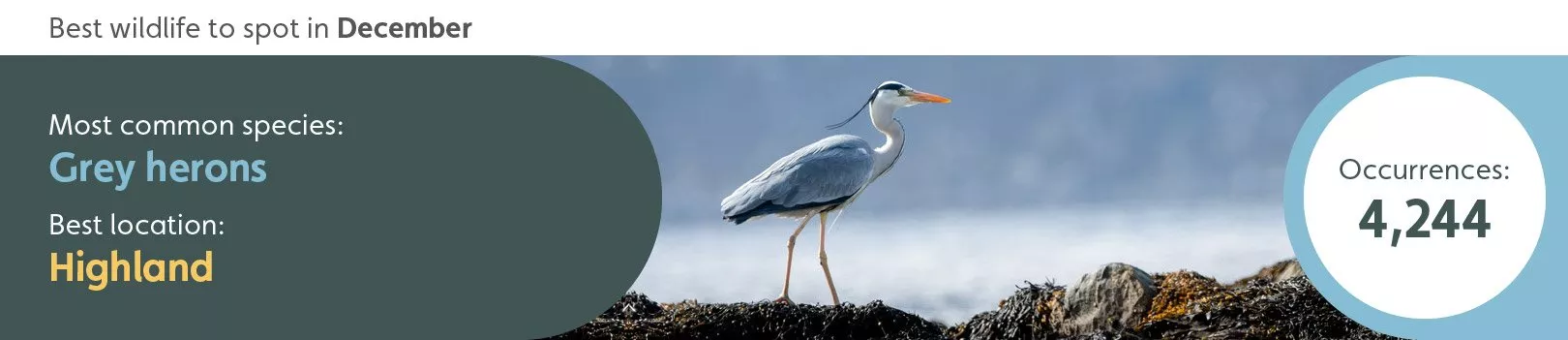
Most common species: Grey herons
Best location: Highland | Occurrences: 4,244
Grey herons are usually very easy to spot with their tall stature, long legs and long beaks, and grey, black and white featherings. They typically eat lots of fish and therefore are usually found near or around water - be it lakes, rivers or garden ponds.
They are one of the best wildlife to spot in December, especially in the Highland area which had a total of 4,244 occurrences from 2018 to 2022.
National parks can make for great places to spot amazing wildlife around the UK. Check out this guide to Britain’s National Parks for inspiration.
Top five wildlife spotting equipment
Walking shoes
When it comes to exploring the great outdoors, walking shoes are essential as they not only help you maintain the proper walking technique but also help prevent you from hurting yourself so you are less likely to suffer severe injuries in the future.
Waterproof clothing
As all outdoor enthusiasts will know, having some sort of protection is important, especially with unpredictable weather conditions. Waterproof jackets offer the best protection from all weather conditions, especially when it’s raining. This is because the waterproof fabric ensures you are kept dry inside and out, whilst also protecting your face and hair from the rain.
Binoculars
Though these are not particularly essential, they are very useful and especially if they are compact as you can carry them with you at all times. You also don't have to spend a large sum of money on binoculars to get a decent pair - very good models are available for less than £100.
Camping gear
If you’re planning on making your wildlife spotting adventure last a little longer then you will most likely need some overnight outdoor supplies. It’s therefore important to pack camping equipment so you’re fully prepared for any unpredictable weather conditions.
Camera accessories
If you’re planning on carrying a camera with you to capture some memorable moments then also consider taking with you some camera accessories. Not only can these accessories help you take better photos but they also keep your equipment safe and secure. Having additional batteries and memory cards at hand will help ensure you don’t miss a single moment!
Methodology
For this research, we explored the best destinations to spot amazing wildlife in the UK. To find out the number of species by local authority, we used information from the NBN Atlas website. This highlighted which areas of the country have the most unique wildlife.
Looking specifically at 50 local authorities, we reviewed factors such as the best wildlife locations in the UK, using articles like The Guardian and CountryLiving. We also looked at the population of each local authority using data from the Office of National Statistics, to add some variety to the data. With this information, we calculated the number of occurrences of wildlife by species from 2018-2022 per 10,000 population.
Using NBN Atlas, we collected the most commonly spotted species from each local authority from 2018 to 2022. For this data, we specifically looked at species that have occurred at least one hundred times or more for each Local Authority. We also used this source for the rarest wildlife section but instead, we looked at a list of 50 species that were only spotted once in the same period.
We also looked at the best months to see different types of species. For this information, we used RSPBs Nature’s Calendar, which provides a detailed monthly guide that aligns with specific species, showing the best time to see certain kinds of wildlife.
By looking at the local authorities with the highest number of occurrences for various species, we ranked each species by how common they are spotted in these local areas and also which month they are most likely to be seen.
To make this section more interesting, we also looked at five top pieces of equipment for wildlife spotting. For this, we used sources such as the RSPBs, useful bird-watching equipment and choosing bird-watching equipment.
In addition to this, we also looked at the average expenditure on the UK’s biodiversity compared to international biodiversity, from 2020/2021, by looking at JNCC. We compared this to over 25 other countries by looking at OECD’s environmental protection expenditure accounts from 2019. These figures for each country were sourced from World Population Review and then calculated per one million people by dividing the total expenditure by the population of that country.
The currencies were originally sourced in each country's own currency but for consistency, these figures were converted into GBP on 21/02/2023 using Google Finance.
Please note that all data collection was completed on 21/02/2023.